SaaS Sales Funnel vs. Marketing Funnel: Why Treating Them as One Is Killing Your Attribution
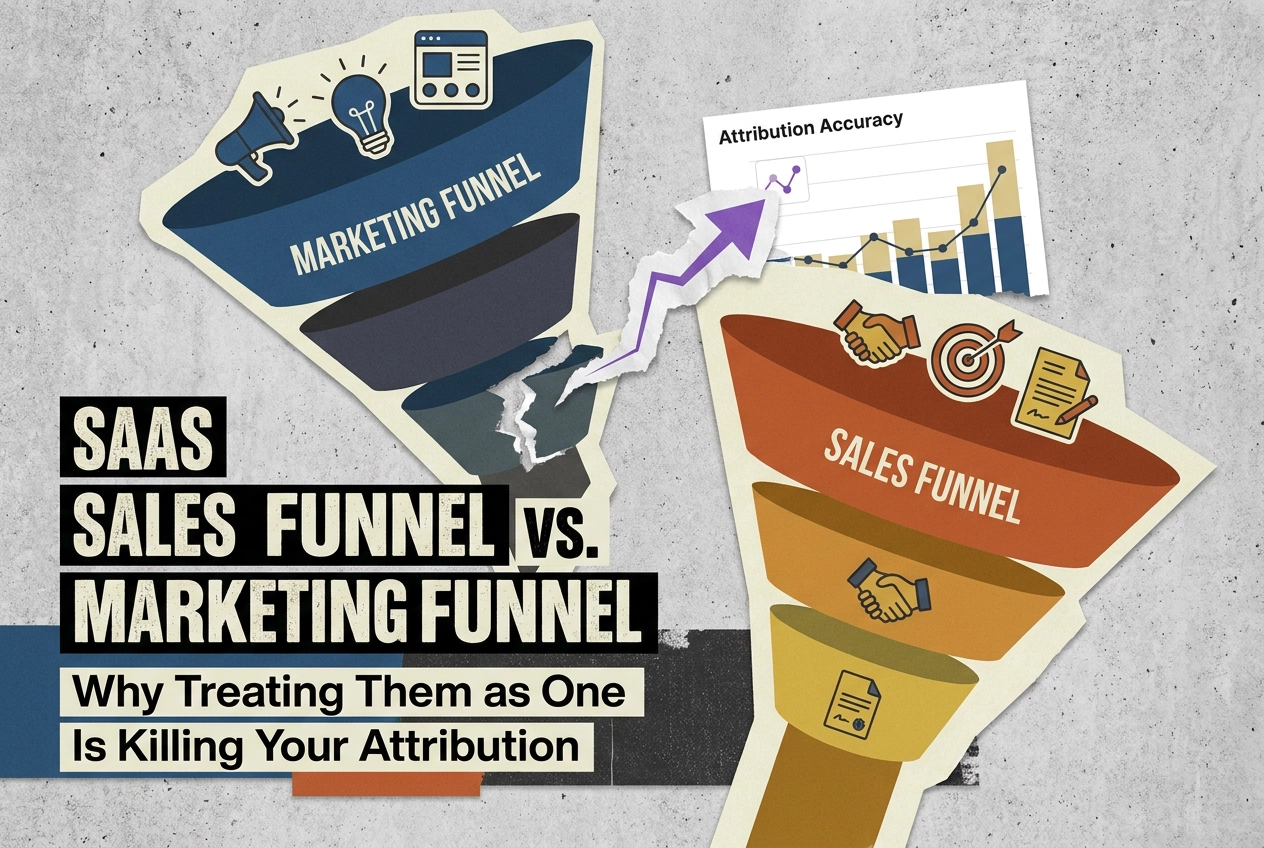
Most SaaS teams think they have an attribution problem. What they actually have is a funnel definition problem, and attribution is just where the damage shows up.
The sales funnel vs marketing funnel distinction sounds like a semantics debate until you realize your marketing team is being held accountable for pipeline that their channels never actually influenced, while your sales team is optimizing stages that were already decided before a rep ever made contact. When both funnels live inside the same dashboard, the data looks coherent but the conclusions are consistently wrong.
This analysis defines exactly where that breakdown happens. You will learn how the marketing funnel measures intent and channel efficiency, how the sales funnel measures deal progression and conversion probability, and why applying a single framework across both creates systematic misattribution that quietly misfunds both teams. More importantly, you will get the boundary metric that separates marketing's responsibility from sales', the attribution model logic that changes depending on which funnel you are measuring, and the measurement infrastructure required to track both cleanly without forcing them into a shared view that distorts both.
The Attribution Problem Nobody Is Naming Correctly
When SaaS teams hit an attribution wall, the instinct is to blame the data. The tracking is broken. The CRM isn't logging touchpoints correctly. The attribution tool needs upgrading. These diagnoses feel technical and solvable, which is precisely why they persist. The actual root cause is structural: most SaaS organizations are running two fundamentally incompatible measurement systems inside one dashboard and wondering why the numbers don't hold up.
The marketing funnel and the sales funnel are not two halves of the same model. They measure different things, answer different questions, and belong to different teams. When both are forced into a single linear view, every conversion event becomes ambiguous. You can no longer isolate where pipeline is being created from where it's being advanced. Marketing's channel efficiency metrics and sales' deal progression metrics collide in the same rows, producing blended numbers that neither team can act on with confidence.
The stakes of getting this wrong are not just analytical. Attribution model selection is effectively a budget decision. The model your team uses determines which channels look like top performers and which get defunded at the next planning cycle, independent of their actual contribution to revenue. Research on attribution modeling confirms that current models often lack the sophistication marketers need to trust the results, and that problem compounds when the underlying data conflates two distinct funnel structures.
The pain surfaces as conflict between marketing and sales: disagreements over lead quality, MQL volume, and who actually drove pipeline. These arguments feel like relationship or process failures. They are not. They are symptoms of a measurement architecture that has never drawn a clean boundary between the two funnels. The same attribution blind spot that most SaaS teams never fix sits beneath nearly every version of this conflict.
This piece defines exactly where that boundary belongs, what metric should mark the handoff, and what infrastructure is required to measure both funnels cleanly without collapsing them into one.
What the Marketing Funnel Actually Measures
The marketing funnel is not a sales instrument. It is an intent and efficiency model, built to answer one question: how well is each channel attracting, engaging, and qualifying audiences before any sales motion begins?
Its core metrics reflect that scope precisely. Impression-to-click rate, traffic-to-lead conversion rate, cost per MQL, lead score distribution, and channel-attributed MQL volume are all pre-deal signals. None of them tell you whether a deal will close, how large it will be, or how long it will take. They tell you whether your channels are producing qualified interest at a defensible cost.
Each stage in the marketing funnel maps to an audience behavior, not a buyer commitment. Awareness measures reach and initial engagement. Consideration measures whether an audience is actively evaluating a solution category. Intent measures whether behavioral signals, content consumption patterns, and lead score thresholds indicate readiness for a sales conversation. A lead moving through these stages is demonstrating interest; they are not yet demonstrating purchase probability.
The primary output of a well-measured marketing funnel is channel efficiency: which sources consistently produce MQLs at acceptable cost and volume, and which sources generate traffic and form fills that never convert to qualified leads. For a deeper look at how these efficiency benchmarks differ across funnel stages, The Full Seven-Stage Funnel Benchmark Map provides a useful reference framework.
The failure mode most SaaS teams encounter is importing sales-stage logic into this model. When pipeline value, close probability, or deal cycle length get layered onto marketing funnel data, the result is a blended number that answers neither "are our channels efficient?" nor "are our deals progressing?" Marketing cannot optimize a metric that includes close probability. Sales cannot act on a metric that blends impression data with opportunity stage. Both teams end up reporting on a number that belongs to no one and drives no useful decision.
The marketing funnel's job ends at the handoff. What it produces is a qualified lead; what happens to that lead next is a different measurement problem entirely.
What the B2B Sales Funnel Actually Measures
Where the marketing funnel ends at audience qualification, the sales funnel begins at deal reality. The two models measure fundamentally different things, and that distinction matters more than most SaaS teams acknowledge.
The B2B sales funnel is a deal progression model. It tracks how individual opportunities move through qualification, evaluation, and commitment toward closed revenue. Every stage reflects a buyer's level of commitment and a seller's assessment of deal probability, not how that buyer originally entered your awareness orbit. If you want to understand what B2B selling actually involves at a structural level, the key distinction is that sales stages are seller-controlled checkpoints, not audience behavior signals.
The Metrics That Actually Matter Here
Core sales funnel metrics are deal-health indicators, not channel indicators:
SQL-to-opportunity rate: what percentage of sales-accepted leads become active opportunities
Stage-to-stage conversion rates: industry benchmarks run 40 to 60% from qualified to proposal, and 20 to 35% from proposal to closed-won
Average deal size by stage: signals whether deals are expanding or compressing as they advance
Pipeline velocity: calculated as (number of deals x win rate x average deal size) divided by sales cycle length, this measures how fast revenue is moving through your pipeline
Win/loss ratio: the terminal output of deal health across all preceding stages
None of these metrics carry a channel dimension. A deal sitting in discovery for 45 days is not a content problem or a paid search problem; it is a sales motion problem.
Where Attribution Logic Corrupts the Model
Sales funnel stages map to buyer commitment and deal probability, derived from stage history and rep judgment. When marketing attribution logic gets applied to this data, specifically channel source weighting and impression-to-lead path modeling, it back-credits top-of-funnel channels for pipeline value they did not create. That misattribution inflates the apparent ROI of awareness channels while erasing the sales motion that actually moved the deal to close.
Why a Single Funnel View Systematically Breaks Attribution
Knowing what each funnel measures independently makes the failure mode of combining them easier to see. When both funnels share one data model, the measurement problems don't add up linearly, they compound.
Conversion events get misassigned at the data layer first. A lead nurtured by marketing for 90 days and then closed by a sales rep in two weeks gets credited to whichever touchpoint the attribution model favors, not to the team that actually drove that stage of the journey. The 90 days of nurturing and the two-week close are structurally identical events inside a unified model. The model cannot distinguish them because no boundary exists to distinguish them.
Single-source models make this worse in opposite directions. First-touch attribution over-credits the awareness channel that originally created the lead; last-touch over-credits the sales activity that closed it. Neither reflects what either team actually contributed. This is explored in depth in How Single-Touch Attribution Misfunds Your Commercial Pipeline, but the core damage in a unified funnel context is specific: the model doesn't just misattribute to channels, it misattributes between teams.
Duplicate tracking is the operational symptom. Marketing tracks lead conversion inside CRM workflows. Sales tracks opportunity progression inside their pipeline view. They rarely agree on a shared number, because no shared definition was ever formally encoded.
That definitional gap flows directly into incentive misalignment. Marketing optimizes for MQL volume to hit its targets. Sales qualifies fewer leads as SQLs to protect pipeline quality. Both behaviors are rational given each team's measurement. The conflict that surfaces in quarterly reviews looks like a relationship problem. It is a measurement architecture problem.
The budget consequence compounds with each cycle. Spend flows toward channels that appear to drive pipeline in a blended view. That inflated signal drives more spend in the next cycle, which inflates the misattribution further. The model doesn't self-correct; it self-reinforces.
The MQL-to-SQL Handoff: The Exact Boundary Between Both Funnels
The measurement failures described above share a common root: no one has formally defined where the marketing funnel ends and the sales funnel begins. That boundary has a name: the MQL-to-SQL conversion event.
This is not a lead status label or a CRM hygiene detail. It is the precise organizational line where marketing's accountability stops and sales' begins, and every attribution decision in your revenue model depends on it being explicitly defined.
Marketing owns everything upstream of SQL. Generating intent, building audience pipelines, nurturing leads to qualification thresholds, and delivering volume at acceptable cost per MQL: these are marketing's metrics. Lead score, cost per MQL, and channel-attributed MQL volume are the measures that belong on marketing's side of the ledger. If you are working to optimize conversion across your SaaS funnel, this ownership boundary is where that work has to start.
Sales owns everything downstream of MQL acceptance. Validating fit, advancing opportunities through deal stages, and converting qualified pipeline to closed revenue: these are measured by velocity, stage conversion rate, and average deal value. None of those metrics belong in a marketing attribution report.
The MQL-to-SQL conversion rate is the single connective metric between the two systems. A low rate carries two completely different diagnoses depending on root cause. If marketing is sending leads that do not meet qualification criteria, the fix is upstream: tighten lead scoring, adjust targeting, or revise channel mix. If sales is not working leads within an acceptable response window, the fix is downstream: process, prioritization, or capacity. Conflating the two funnels makes this distinction invisible, so teams apply the wrong fix and the rate stays low.
This is why explicit SQL qualification criteria are a prerequisite, not an optional refinement. Firmographic fit, behavioral signals, budget indicators, and a shared threshold framework (BANT or equivalent) must be agreed upon in writing by both teams. Without a shared definition, the handoff boundary is arbitrary, and any attribution built on top of it is unreliable by design.
Forrester's ongoing revenue process alignment research signals that this conversation has reached the analyst tier. SaaS RevOps teams are increasingly treating the MQL/SQL distinction as a data architecture decision, not an administrative one. The boundary does not just organize responsibility; it determines whether your attribution data is structurally sound.
Attribution Model Selection and Why It Matters More When Funnels Are Conflated
Once the MQL-to-SQL boundary is formally defined, the next decision is equally consequential: which attribution model runs on top of your funnel data. That choice does not just shape a report. It determines which channels receive budget in the next cycle.
Model selection is a budget allocation decision disguised as an analytical one. In a conflated single-funnel view, the model you pick acts as an arbitrary judge between marketing and sales contributions. First-touch models credit the awareness channel that originally acquired the lead, systematically rewarding demand generation. Last-touch models credit the final sales interaction before close, systematically rewarding sales development and closing reps. Neither reflects actual revenue causality. Each simply encodes a different bias into the output.
This is why B2B SaaS teams are moving toward multi-touch attribution models: they distribute credit across the full customer journey rather than concentrating it at one arbitrary endpoint. The problem is that multi-touch models only produce accurate results when the underlying data is clean. Every touchpoint must be correctly tagged to its funnel stage before the model runs. Marketing touchpoints and sales touchpoints are structurally different events and must be treated as such in the data model.
Applying multi-touch attribution to a conflated data set does not solve the attribution problem. It distributes the misattribution more evenly across more touchpoints. The result looks precise because credit is spread across eight or twelve interactions rather than one. But if those touchpoints are mis-staged, the precision is manufactured. You are measuring the wrong thing with greater sophistication.
The structural fix is to run separate attribution models for each funnel. Channel attribution belongs inside the marketing funnel, measuring source efficiency from first touch through MQL. Stage and rep attribution belongs inside the sales funnel, measuring process and conversion efficiency from SQL to close. Before changing any model, build attribution before you scale anything else; a model change on a broken data structure produces a cleaner-looking version of the same wrong answer.
Diagnosing Whether Your Attribution Problem Is a Funnel Conflation Problem
Before reaching for a new attribution tool or rebuilding your reporting layer, run this diagnostic against your current setup. If three or more of these signals are present, the root cause is measurement architecture, not data quality.
Signal 1: Marketing and sales argue about lead quality every quarter. This recurring conflict is almost never a relationship problem. When both teams use different implicit definitions of what counts as a conversion, their numbers will never agree. The disagreement is a symptom; the undefined conversion boundary is the disease.
Signal 2: Your MQL-to-SQL conversion rate is unknown or ignored. If this number is not tracked, reported, and acted on as a diagnostic metric, the handoff boundary has not been formally encoded in your data model. A low MQL-to-SQL rate means either marketing is sending unqualified leads or sales is not working them promptly. Those are opposite problems requiring opposite fixes, and you cannot distinguish them without this metric.
Signal 3: One channel claims a disproportionate share of attributed pipeline. When paid search or content consistently appears responsible for 60-80% of pipeline, the likely culprit is a first-touch or last-touch model applied to a unified funnel view, not genuine channel dominance. As performance marketing budgets face growing scrutiny over vanishing revenue traces, over-crediting a single channel is one of the most expensive misdiagnoses a SaaS growth team can make.
Signal 4: Budget reviews require manual reconciliation between two reports. If marketing's lead report and sales' pipeline report do not reconcile automatically, that gap is a direct consequence of duplicate tracking across conflated funnel data. Clean separation eliminates the reconciliation step because both funnels pull from one connected but distinct data model.
Signal 5: Cost per SQL requires combining data from multiple systems. This calculation should be native to your measurement model. If answering it means exporting from a CRM, cross-referencing a marketing dashboard, and running the math in a spreadsheet, your funnel architecture is the problem.
If these signals are present, adding a new attribution tool will not fix them. Reporting layer changes applied to a broken measurement architecture produce cleaner-looking numbers that are still wrong.
The Measurement Infrastructure to Run Both Funnels Cleanly
Once you've diagnosed the conflation problem, the fix is not a new attribution model. It is a deliberate separation of the underlying data architecture.
Separate your data models first. Marketing funnel data, including lead source, channel, campaign, touchpoint sequence, and lead score, should live independently from sales funnel data: opportunity stage, deal value, sales rep, velocity, and close probability. These two datasets connect at exactly one point, the MQL-to-SQL handoff event. That event is a timestamp, a conversion record, and a stage boundary. Everything upstream belongs to marketing's model; everything downstream belongs to sales'.
Build shared but distinct dashboards. Marketing needs a view optimized for channel efficiency and MQL pipeline health. Sales needs a view optimized for deal progression and pipeline velocity. Neither team benefits from seeing the other's primary metrics in their core dashboard. The one shared view that both teams should have access to is the handoff view, showing MQL-to-SQL conversion rate as the single connective metric between both funnels. That rate is where attribution accountability crosses the boundary.
Unify your data layer without blending your stage logic. Both funnels should feed a single data warehouse or analytics layer, with clear stage tagging that preserves which funnel each event belongs to. This allows cross-funnel analysis when needed, for instance calculating true cost-per-SQL, without collapsing the two models into one. This unified-but-separated architecture is the infrastructure gap most SaaS teams currently lack. For guidance on what each funnel view should contain, what a SaaS funnel dashboard should actually contain is worth reviewing before you build.
Account for your CRM's default behavior. Most CRM configurations default to a unified object model that treats leads and deals as sequential stages in one record. Achieving clean separation typically requires custom object configuration, explicit lifecycle stage mapping, and a deliberate data pipeline that maintains the boundary rather than collapsing it at sync time.
FunnelKeeper's dashboard architecture is built around this separation by design. Marketing and sales each operate their own funnel views, connected at the handoff point, without attribution data bleeding across both sides.
The goal is not two siloed systems. It is two connected, distinct measurement models that share one handoff metric and keep attribution clean on both sides of it.
Migrating From a Unified Funnel Model to Separated Measurement
With the infrastructure model defined, the next step is executing the transition without breaking the reporting your teams depend on today.
Step 1: Audit current funnel stages. Pull every dashboard, CRM report, and attribution view your teams use actively. Flag any metric that combines marketing and sales data in a single number, blended conversion rates, unified pipeline reports, any stage labeled ambiguously as "qualified." Each flag marks a boundary that needs to be formally defined before you rebuild.
Step 2: Define SQL qualification criteria in writing. Verbal agreements on lead quality erode within one quarter. Document the exact firmographic requirements (company size, industry, geography), behavioral triggers (demo request, pricing page visits, engagement score threshold), and any BANT-equivalent criteria that must be satisfied before sales accepts a lead. Both marketing and sales leadership sign off. This document becomes the operational definition that anchors your entire separated model.
Step 3: Reconfigure MQL and SQL as a handoff event, not sequential statuses. In most CRM configurations, MQL and SQL are just adjacent fields in a lead record. That treats the handoff as a label change rather than a conversion event. Reconfigure it so the transition from MQL to SQL generates a timestamped, logged event that is reportable independently. Your MQL-to-SQL conversion rate becomes a real metric with a real denominator, not a manual calculation across two spreadsheets.
Step 4: Rebuild attribution models separately for each funnel. Implement channel attribution exclusively upstream of the handoff, measuring source efficiency from first touch to MQL. Implement stage and rep attribution exclusively downstream, measuring deal progression from SQL to close. Connect the two models only through the handoff conversion rate. Running separate attribution logic prevents the model from distributing credit across funnel stages that have no causal relationship to each other.
Step 5: Run a 30-day parallel validation period. Keep the old unified model running alongside the new separated model. Compare their MQL-to-SQL rates and channel attribution outputs against known ground truth. If the numbers diverge from what your team observes in practice, the new model has a configuration error. Deprecate the old view only after the new model passes this validation.
Migration timelines vary based on CRM complexity and the number of active attribution touchpoints; simpler stacks can move quickly, while highly customized pipelines require more validation time.
Two Funnels, One Handoff, Clean Attribution
Once the migration is complete, the most important thing to hold onto is the principle that made it necessary.
Each funnel measures distinct things and connects only at the MQL-to-SQL handoff, that principle is what makes the following actions stick.
Run the five-signal diagnostic from the earlier section first; it tells you whether you need infrastructure or just a cleaner boundary.
Of every action available, agreeing on shared SQL qualification criteria reviewed quarterly resolves more attribution conflict than any tool change.
Then audit your dashboards with one direct question: are you running one blended funnel view or two connected but separated views? If you cannot answer that confidently, you are running one blended view.
Teams that complete this separation gain something that matters beyond cleaner reports. Each team can defend its budget independently, with metrics that reflect its actual contribution. Marketing can demonstrate channel efficiency up to the handoff. Sales can demonstrate conversion efficiency from the handoff forward. The quarterly attribution argument does not get resolved by better data alone; it gets resolved by a measurement architecture that never required both teams to share the same number in the first place.

Conclusion
Conflating your marketing and sales funnels does not create a data problem; it creates a structural problem that data alone cannot fix. Separation gives both teams defensible metrics they actually own, and the MQL-to-SQL handoff is the boundary that makes that ownership real.
Teams that make this separation stop debating whose numbers are wrong and start proving where value is actually created. Clean attribution is not a reporting upgrade; it is an organizational advantage. Draw the boundary, separate the funnels, and let the results speak for themselves.